
Most of what passes for situational awareness training is someone else's framework with the hard parts removed.
This happens across situational awareness training. Daniel Kahneman's WYSIATI gets turned into "trust your gut." Col. John Boyd's OODA loop becomes "act fast." Greg Williams' work on behavioral baselines becomes a checklist. Someone prints it and hands it out at a conference. In every case, the original idea required years of research, field testing, and operational refinement. The version that spreads requires a graphic designer and thirty minutes.
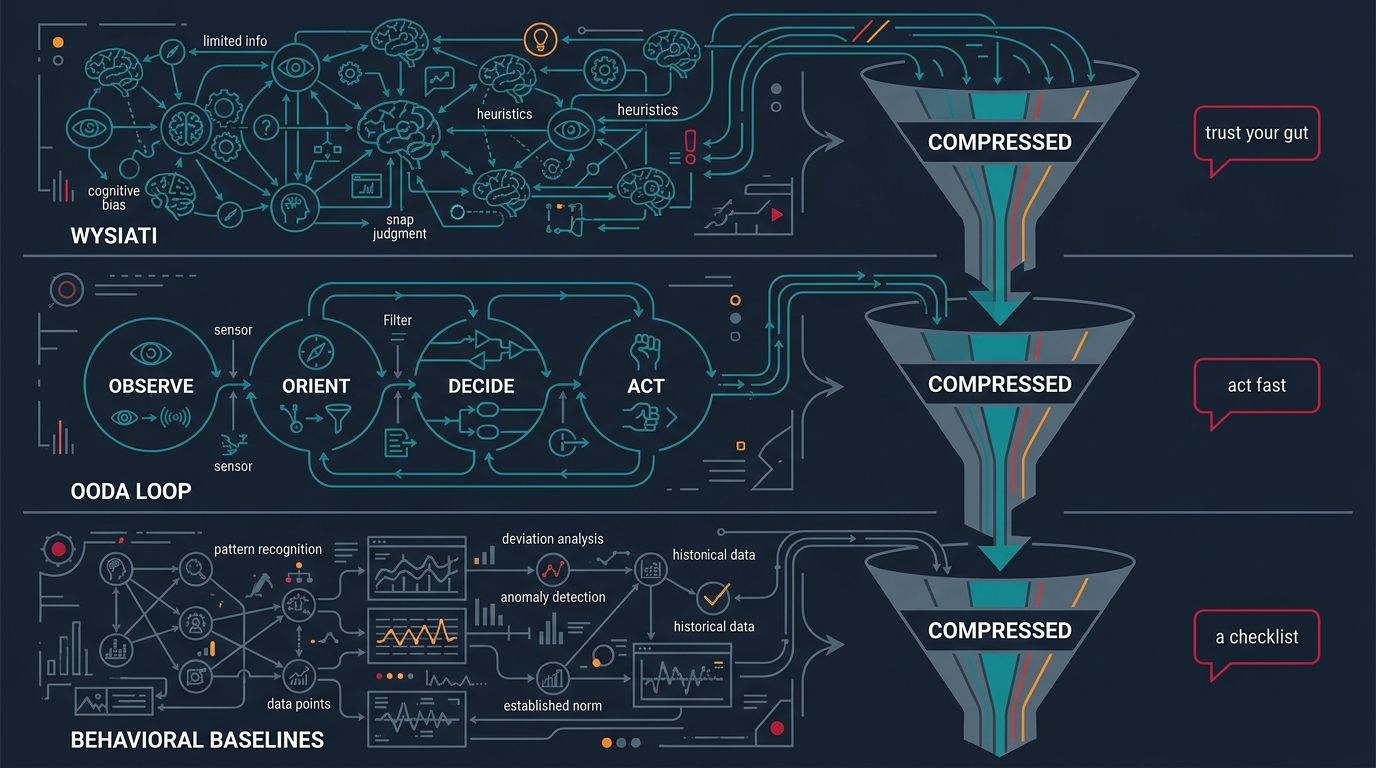
You have encountered these versions. You may have taught them. And they probably felt right, because they were coherent and they were easy to remember. That is the problem.
WYSIATI: What You See Is All There Is
Kahneman spent a career studying why coherent stories feel true even when they are incomplete. He gave the phenomenon a name: WYSIATI. What You See Is All There Is. The brain takes whatever information is available. It assembles the best possible narrative. Then it treats that narrative as the whole picture. It never raises a flag. It never says "wait, there might be more." As Kahneman wrote: "You build the best possible story from the information available to you, and if it is a good story, you believe it. Our comforting conviction that the world makes sense rests on a secure foundation: our almost unlimited ability to ignore our ignorance."
Read that again. He is not describing a flaw in careless people. He is describing the default operating system of every human brain. Yours included. The simplified version of his work removes this mechanism and keeps only the conclusion: people have biases. That is true. It is also useless. Knowing you have biases does not tell you where they are hiding or how they operate when you need to make a decision in two seconds. The mechanism is the part that matters. And the mechanism is the part that got removed.
The OODA Loop, as Boyd Built It
Col. Boyd had the same problem happen to his work. It started while he was still alive. The OODA loop gets taught everywhere. Observe. Orient. Decide. Act. Four steps in a circle. Go faster than the other guy. That is what most people learn. That is not what Boyd built.
Boyd spent decades developing a theory of conflict. It placed orientation at the center of everything. Orientation is not a step you pass through. It is the lens you permanently look through. In his 1995 briefing "The Essence of Winning and Losing," he wrote that orientation "shapes observation, shapes decision, shapes action, and in turn is shaped by the feedback and other phenomena coming into our sensing or observing window." In Boyd's model, orientation is the sum of your genetic heritage, cultural traditions, previous experience, and every piece of analysis and synthesis you have ever performed. It determines what you see. It determines what you miss. It determines which options occur to you. It also determines which ones never cross your mind.
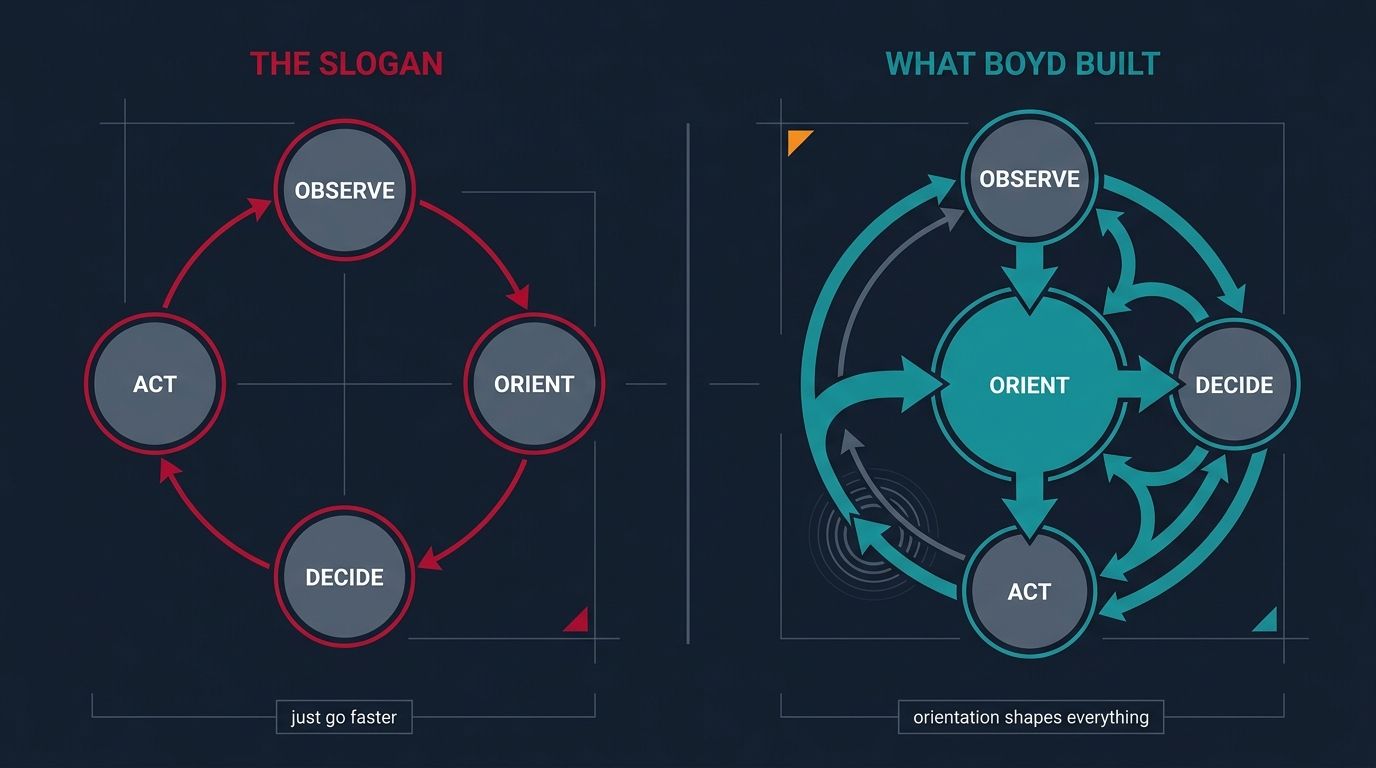
When someone reduces this to "act faster," they remove the only component that explains why people fail. Speed without accurate orientation is just arriving at the wrong answer sooner. The person teaching "act faster" does not know they removed anything. Their orientation was never built to see it.
That is not an insult. That is the Dunning-Kruger effect applied to someone else's life work. The skills needed to evaluate a framework are the same skills the framework was designed to build. If you never had them, you cannot know what you are missing. You just know the story feels complete.
Trained Perception, Not a Checklist
Greg Williams understood this operationally. He did not just theorize about the gap between what people think they see and what is actually there. He built a method to close it. He started with Combat Profiling for the Marine Corps. It evolved into HBPR&A, Human Behavior Pattern Recognition and Analysis. Williams created a discipline that trains people to establish environmental baselines and detect anomalies against them. Not from a checklist. From trained perception.
The difference matters. A checklist tells you what to look for. It is static. It works until the environment changes, which it always does. A trained baseline reader sees what does not belong. They have learned to perceive the environment as a living system. Its patterns can be read, measured, and analyzed. This is situational awareness as a trained discipline. Williams' programs have been tested in combat and validated by researchers. They have been refined across military, law enforcement, airline security, and school safety applications. Compare that to a "look at your environment and understand the risks it poses" post. The distance between them is the distance between a discipline and a slogan.
And here is where it gets personal. If you have been in this industry long enough, you have sat through training that felt solid. You took notes. You remembered the key points. You may have even taught those points to your team. But that training may have come from someone who learned the compressed version. If so, what you received was a copy of a copy. Each generation of compression loses fidelity. The mechanism fades. The labels remain. The labels are the part that feels like knowledge.
Kahneman again: "Considering how little we know, the confidence we have in our beliefs is preposterous." The person who taught you the simplified version was probably the most confident that they had it right. Kahneman and Boyd demonstrated this independently. Confidence is not a measure of accuracy. It is a measure of coherence. The fewer the pieces, the easier the puzzle. The easier the puzzle, the more certain you feel about the picture you built from it.
The pattern is the same every time. Someone takes work that was built to change how people think. They strip it down to what is easy to repeat. Then they sell the feeling of understanding without the substance of it. Sometimes this is deliberate. More often they genuinely believe they captured the idea. They do not know what they removed. They were never oriented to see it was there.
That is not a knowledge gap. That is the illusion of knowledge. And it is more dangerous than ignorance because it comes with confidence attached.
The people who actually developed these frameworks did not make them simple. The frameworks are not simple. Kahneman published over 200 papers before writing the book that most people only read the summary of. Boyd briefed "Patterns of Conflict" for hours at a time. He still considered it unfinished when he died. Williams has spent over 30 years refining a method that is still evolving.
The question worth sitting with is not whether situational awareness matters. Everyone agrees it matters. The real question is different. Did the version you learned come from the source? Or did it come from someone who made it easier to digest?
And if it was easier to digest, what was removed?
Sources
Daniel Kahneman, Thinking, Fast and Slow (Farrar, Straus and Giroux, 2011).
Col. John R. Boyd, USAF. "The Essence of Winning and Losing" (briefing, 1995). "Destruction and Creation" (1976). "Patterns of Conflict" (briefing, 1986).
Greg Williams. Arcadia Cognerati. Creator of Combat Profiling (USMC Combat Hunter Program) and HBPR&A (Human Behavior Pattern Recognition and Analysis).